


Driving Instructor-Theory Test
Naz Digital
Learning to drive is often less about memorising a few signs and more about building a reliable habit of noticing risk, rules and road situations before they become stressful. I spent time with Driving Instructor-Theory Test as a study companion, and I found it most useful when treated as a focused practice tool rather than a complete replacement for an instructor. It belongs to the Auto & Vehicles category, is free to install, and is aimed at people who want to strengthen their theory knowledge on a phone.
The app is developed by Naz Digital and has built a solid audience, with over five million installs and a 4.2 average from around six thousand ratings. Those figures suggest that it is not an obscure experiment, but they do not automatically make it right for every learner. My impression is that its value depends heavily on how you use it: a few rushed quizzes will not do much, while short, repeated sessions can make revision easier to fit around normal life.
How it fits into a shared household
The most realistic use case for me is a shared-device household. Imagine one person preparing for a theory test while another family member uses the same phone for navigation, messages or everyday tasks. The learner can open the app for a short revision session during a quiet moment, work through questions, and hand the device back without needing a desk, a book or a separate computer.
That convenience matters because theory study is easy to postpone. A printed manual tends to stay in a bag, while a phone is usually already nearby. I would use the app while waiting for an appointment, during a lunch break or at home after dinner. The important point is to make those sessions deliberate. Opening it for two minutes and guessing through questions is much less useful than choosing a calm block of time and reviewing mistakes properly.
Shared use also creates a practical boundary: the app should be treated as a personal study space, even when the phone is communal. If several people are preparing for tests, each person needs to remember where they stopped and which topics caused trouble. I would avoid assuming that progress, answers or revision history automatically belong to separate household members. Unless the person using the device has clearly established their own account or profile arrangement, the safest approach is to regard the app as one shared workspace.
Latest News

Uber Eats Under Pressure: What Happens When Delivery Goes Wrong

How QR & Barcode Scanner Adapts to Android and iOS Innovations

Why Waze Navigation & Live Traffic Is Your Essential Travel Companion

CapCut Mastery: Unleash Hidden Features for Pro-Level Editing

How OS Updates Enhance Roblox Adventures

Teacher Simulator: Exam Time Turns Quick Classroom Judgments into a Repetitive Loop
That does not make it unsuitable for families. It simply changes the routine. One learner can complete a session, note the areas that need attention, and then let another person use the phone. A small paper note or a shared household reminder can be more dependable than trying to make the app serve several identities at once. This is one of those details that is easy to overlook when choosing a study app, but it affects whether the experience feels organised or confusing after a week of shared use.
Setting up a sensible study boundary
I would begin by deciding what the app is for. Its store summary presents it as a way to develop driving skills and prepare for licensing success, but I would use it specifically for theory revision. That distinction keeps expectations realistic. It can help you practise knowledge, recognise weak areas and become more comfortable with test-style thinking; it cannot observe your steering, braking, mirror checks or judgement in live traffic.
For a new learner, the best setup is not to start with the goal of completing as many questions as possible. Instead, I would keep a simple routine: use one session to answer carefully, then spend the next few minutes examining any uncertainty. If a question feels familiar but the answer is still a guess, I would count it as a topic to revisit. A correct guess is not the same as dependable understanding, especially when road rules are applied in unfamiliar situations.
Gallery
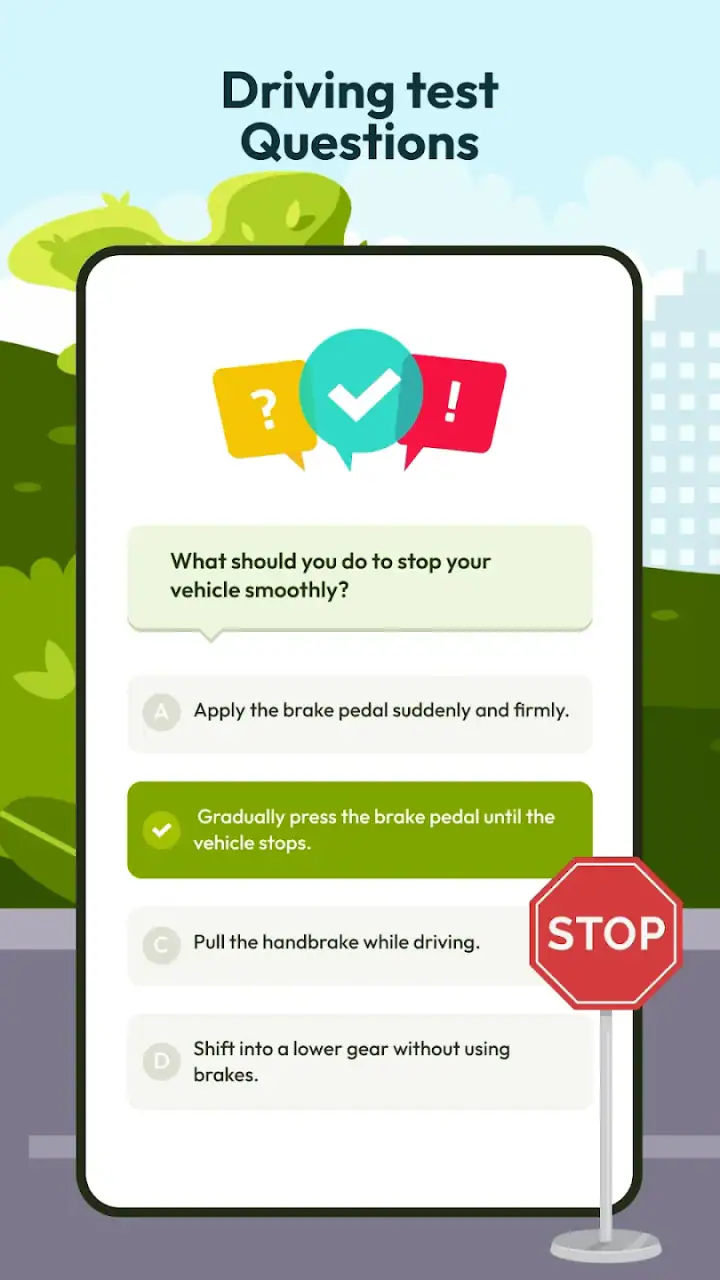
On a shared phone, I would also establish a clear start and stop point. Before beginning, check that the device is not needed by someone else. At the end, close the session and leave a note about the next topic rather than leaving the app open indefinitely. This is basic coordination, but it prevents the learner’s revision from becoming mixed with someone else’s casual use of the phone.
There is another boundary worth keeping in mind: do not use a practice result as proof that you are ready to drive independently. A strong quiz performance can show that your recall is improving, but road safety requires practical instruction and experience. I see Driving Instructor-Theory Test as a bridge between lessons, not a substitute for lessons. That makes it a better fit for a learner who already understands that theory and practical driving need to support each other.
Coordinating revision without turning it into pressure
When more than one person in a household is involved, coordination can either help or become irritating. I would avoid turning the app into a scoreboard. Comparing who answered more questions may create pressure without improving understanding. A better arrangement is to share useful observations: one person might discover that signs are causing difficulty, while another may need more work on hazard awareness or rule interpretation.
This approach is especially helpful when a parent, partner or older sibling is supporting a learner. The supporter can ask what felt difficult rather than demanding a score. That leaves the learner responsible for their own progress while still making it easier to plan the next session. The app becomes a conversation starter, not a tool for monitoring every study moment.
For a household with limited time, I would coordinate around predictable gaps. A learner might complete a short session before school or work, while another person uses the same device later in the evening. The exact schedule is less important than consistency. Because the app is free to install, it is easy to try this routine without committing money at the outset, although optional in-app purchases range from around five dollars to around thirty-six dollars per item. I would not spend on extras until the free experience has proved useful for the specific learner.
That is also where the app compares favourably with traditional alternatives. A printed theory book can offer broader explanation and may be easier to annotate, but it does not give the same quick, interactive practice on a shared phone. A driving instructor can explain mistakes in context, but lessons are more limited and should be reserved for practical development as well as questions. Driving Instructor-Theory Test sits between those options: more active than passive reading, but less personal and comprehensive than guidance from a qualified instructor.
What I would watch for during practice
My most useful habit with this kind of app is to separate speed from confidence. If I answer quickly, I ask myself whether I recognised the rule or merely remembered the shape of a previous question. That small pause turns practice into learning. I would also revisit questions that were answered correctly for the wrong reason, because those misunderstandings can remain hidden when the only focus is the final result.
A second useful workflow is to group mistakes by cause rather than by individual question. For example, if several errors come from confusing similar signs, the problem is probably recognition rather than memory of one isolated answer. If mistakes appear when a situation includes several road users, the learner may need to slow down and think about priorities and risk. The app can provide the prompt, but the learner has to do this diagnosis themselves.
A third insight concerns tiredness. Theory apps are convenient enough to encourage late-night revision, yet tired guessing can create false confidence. I would stop when concentration drops, even if that means completing fewer questions. A shorter session with careful reasoning is more valuable than a long session where answers are selected automatically. This is particularly important on a shared device, where interruptions can make an already distracted session even less reliable.
I would also keep practical lessons connected to the topics that feel difficult in the app. If a learner repeatedly struggles to understand a road situation, that is a useful subject to raise with an instructor. The app cannot explain every personal misunderstanding in the same way a teacher can, but it can help identify what to ask about. That makes it more valuable than using it as a simple pass-or-fail simulator.
Age, trust and the role of an adult supporter
The content rating is Everyone, which makes the app broadly suitable for a general audience, but that should not be confused with every learner having the same needs. A younger person may need an adult to explain unfamiliar road language, while an older learner may prefer to study privately and at their own pace. In both cases, trust matters more than supervision for its own sake.
I would not treat an adult’s access to the shared phone as permission to inspect every detail of a learner’s activity. The healthier arrangement is to agree on the purpose of the practice and discuss progress openly. If the learner wants help, an adult can sit beside them and talk through a difficult situation. If the learner prefers independent study, that choice should usually be respected unless there is a clear safety concern.
Account boundaries deserve attention here. I would not assume that the app provides household profiles, parental controls or a special family dashboard. If those features are essential to your home, this may not be the right choice. A family can still coordinate manually, but that requires honesty about who is using the device and care not to mistake one person’s results for another’s.
The same principle applies to purchases. Since the app is free but includes optional items, I would make sure the device owner and learner understand that free access and paid extras are separate decisions. In a shared household, an adult should handle any purchase discussion clearly rather than leaving a child or another family member to work it out accidentally. This is not a reason to avoid the app, but it is a reason to establish expectations before several people use it.
Where it is strong and where another option wins
I like the app most for flexible repetition. It is a practical choice for someone who already has access to driving lessons and wants extra theory practice between them. It is also useful for a learner who dislikes carrying a book or who benefits from responding to questions instead of only reading explanations. The current version is 1.7.3, and support begins with Android 7.0, so it can suit people using older compatible Android phones rather than requiring the newest hardware.
Its weaker side is the risk of shallow learning. Any quiz-based tool can become a pattern-recognition exercise if the user focuses only on finishing. Someone who needs detailed teaching, local clarification or personalised correction may be better served by an instructor, a structured driving-school course or a well-explained theory manual. I would also choose another option if separate household accounts and tightly managed progress tracking are central requirements.
The app is not the best fit for a person who has not yet learned the basic vocabulary of driving. In that situation, unfamiliar terms may make questions feel harder than they really are. I would begin with instruction or reading, then use the app to reinforce the concepts. Conversely, a learner who already understands the material but needs frequent recall practice may find the phone format exactly right.
It is worth remembering that the app is free, but free entry does not mean every possible part of the experience is necessarily included without cost. I would explore the available practice first, decide whether the question style suits me, and only then consider an optional purchase. That approach avoids paying for an upgrade before knowing whether the app fits the learner’s study habits.
My household verdict
After using Driving Instructor-Theory Test as a revision companion, I would recommend it to a learner who wants convenient theory practice and is willing to think about mistakes rather than chase quick scores. Its strongest role is between lessons, during short gaps in the day, or in a household where a shared phone needs to support several routines without becoming another piece of clutter.
I would set clear boundaries from the beginning: one person should know whose session is active, household members should not assume separate progress unless the app visibly supports it, and purchases should be discussed before they happen. Those simple rules make shared use smoother and protect trust, especially when a younger learner is involved.
My final view is positive but measured. This is a useful, accessible study aid from Naz Digital, with a broad Everyone rating and a large existing user base. I would choose it for repetition, confidence building and identifying questions to raise with an instructor. I would not choose it as the only source of driving education, as a replacement for practical lessons, or for a family that needs advanced account separation.
Use it as a regular practice partner, not as the whole learning journey. With that expectation, the free app can earn its place on a learner’s phone and make theory revision easier to fit into real household life.
FAQs for Driving Instructor-Theory Test
What is Driving Instructor-Theory Test?
Driving Instructor-Theory Test is an educational app designed to help users prepare for their driving theory test. It features a comprehensive set of practice questions, mock exams, and interactive learning tools that simulate the real test environment. The app is suitable for learners of various skill levels, providing detailed feedback and progress tracking.
Is the content in Driving Instructor-Theory Test up-to-date with current regulations?
Yes, the app regularly updates its content to align with the latest driving regulations and test standards. This ensures that users are practicing with the most relevant and accurate information, helping them to better prepare for the actual theory test and increase their chances of passing.
What features does Driving Instructor-Theory Test offer to enhance learning?
Driving Instructor-Theory Test includes features such as customizable practice tests, detailed explanations for each question, progress tracking, and interactive learning modules. These tools are designed to enhance understanding and retention of driving rules, making learning more engaging and effective for users.
Can I use Driving Instructor-Theory Test offline?
Yes, once the app is downloaded, many features can be accessed offline, allowing users to study and practice without an internet connection. This is particularly useful for users who want to learn on the go or in areas with limited internet access.
Is Driving Instructor-Theory Test suitable for all age groups?
Driving Instructor-Theory Test is primarily designed for new drivers preparing for their theory test, regardless of age. However, it can also be a valuable refresher for licensed drivers who want to brush up on their knowledge of driving rules and regulations. The app’s user-friendly interface makes it accessible to a wide age range.
Pros
- Comprehensive question database.
- User-friendly interface design.
- Offline access available.
- Regular content updates.
- Detailed explanations for answers.
Cons
- Limited customization options.
- Some ads in free version.
- Occasional app crashes reported.
- No voice-over feature.
- Requires internet for updates.


